Alzheimers & Dementia2024
A multi‐view learning approach with diffusion model to synthesize FDG PET from MRI T1WI for diagnosis of Alzheimer's disease
Ke Chen, Ying Weng, Yueqin Huang, Yiming Zhang, Tom Dening, Akram A. Hosseini, Weizhong Xiao
INTRODUCTION
This study presents a novel multi-view learning approach for machine learning (ML)–based Alzheimer's disease (AD) diagnosis.
METHODS
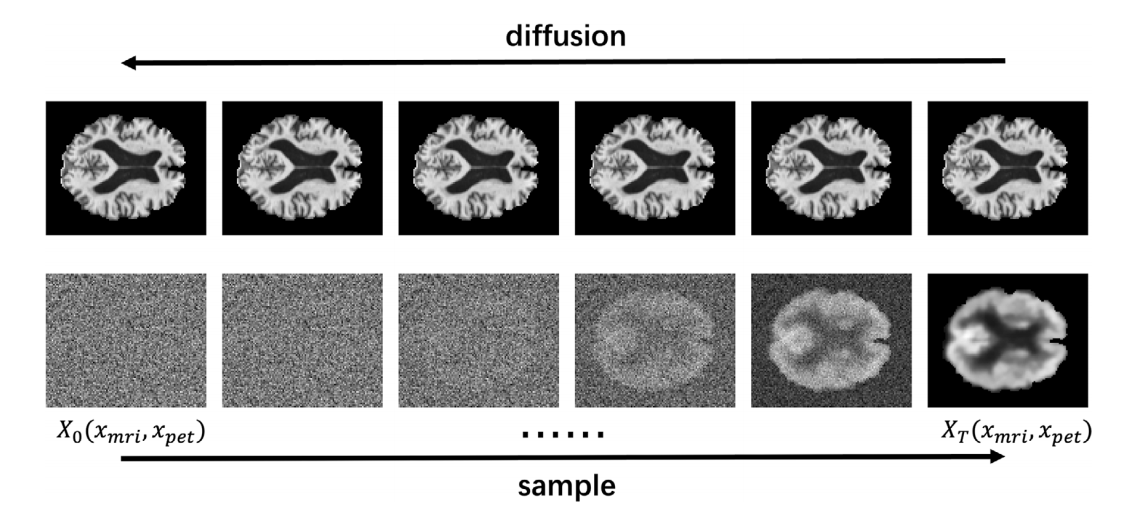
A diffusion model is proposed to synthesize the fluorodeoxyglucose positron emission tomography (FDG PET) view from the magnetic resonance imaging T1 weighted imaging (MRI T1WI) view and incorporate two synthesis strategies: one-way synthesis and two-way synthesis. To assess the utility of the synthesized views, we use multilayer perceptron (MLP)–based classifiers with various combinations of the views.
RESULTS
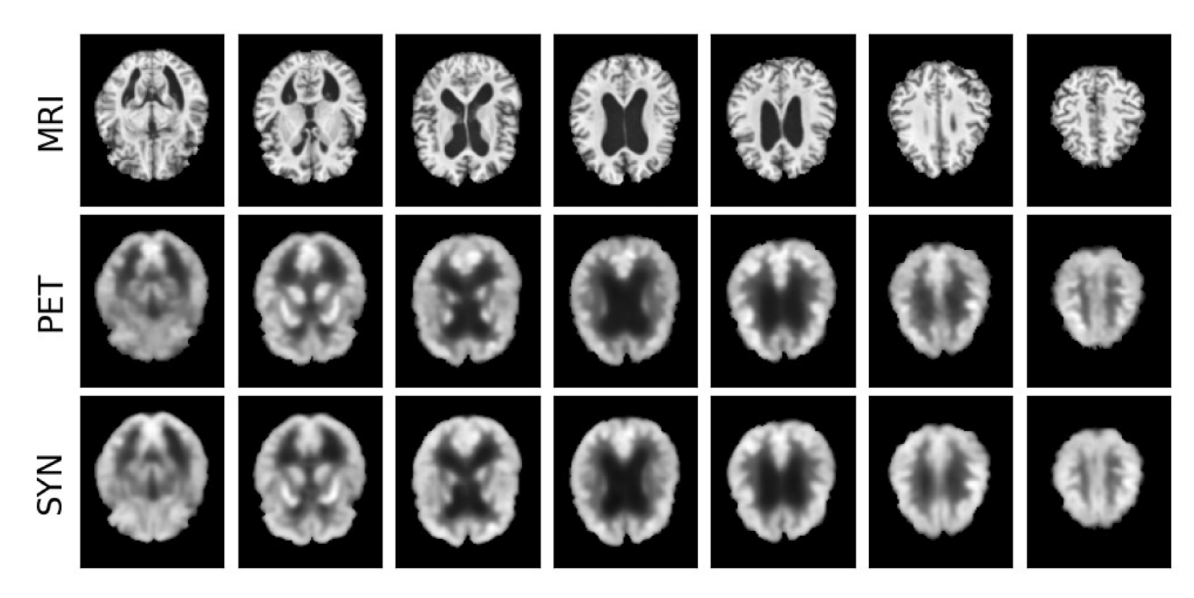
The two-way synthesis achieves state-of-the-art performance with a structural similarity index measure (SSIM) at 0.9380 and a peak-signal-to-noise ratio (PSNR) at 26.47. The one-way synthesis achieves an SSIM at 0.9282 and a PSNR at 23.83. Both synthesized FDG PET views have shown their effectiveness in improving diagnostic accuracy.
DISCUSSION
This work supports the notion that ML-based cross-domain data synthesis can be a useful approach to improve AD diagnosis by providing additional synthesized disease-related views for multi-view learning.
Alzheimer's DiseaseData SynthesisDiffusion ModelFGD-PETMRI-T1WIMulti-view Learning
Neural Networks2024
A comparative study of GNN and MLP-based machine learning for the diagnosis of Alzheimer's Disease involving data synthesis.
Ke CHEN, Ying Weng, Akram A. Hosseini, Tom Dening, Guokun Zuo, Yiming Zhang
Alzheimer’s Disease (AD) is a neurodegenerative disease that commonly occurs in older people. It is characterized by both cognitive and functional impairment. However, as AD has an unclear pathological cause, it can be hard to diagnose with confidence. This is even more so in the early stage of Mild Cognitive Impairment (MCI). This paper proposes a U-Net based Generative Adversarial Network (GAN) to synthesize fluorodeoxyglucose - positron emission tomography (FDG-PET) from magnetic resonance imaging - T1 weighted imaging (MRI-T1WI) for further usage in AD diagnosis including its early-stage MCI. The experiments have displayed promising results with Structural Similarity Index Measure (SSIM) reaching 0.9714. Furthermore, three types of classifiers are developed, i.e., one Multi-Layer Perceptron (MLP) based classifier, two Graph Neural Network (GNN) based classifiers where one is for graph classification and the other is for node classification. 10-fold cross-validation has been conducted on all trials of experiments for classifier comparison. The performance of these three types of classifiers has been compared with the different input modalities setting and data fusion strategies. The results have shown that GNN based node classifier surpasses the other two types of classifiers, and has achieved the state-of-the-art (SOTA) performance with the best accuracy at 90.18% for 3-class classification, namely AD, MCI and normal control (NC) with the synthesized fluorodeoxyglucose - positron emission tomography (FDG-PET) features fused at the input level. Moreover, involving synthesized FDG-PET as part of the input with proper data fusion strategies has also proved to enhance all three types of classifiers’ performance. This work provides support for the notion that machine learning-derived image analysis may be a useful approach to improving the diagnosis of AD.
Alzheimer’s Disease (AD)Synthesis modelGraph Neural Network (GNN)Data fusion